

Last Updated:September 15, 2026
Immigration through the Live-in Caregiver Program
Ms. Masako
About 9 months
Caregiver
First, I would like to add a note.
My case is quite unusual, so please read it as just one example.
What made you decide to study in Canada?
I majored in early childhood education and social welfare. When I was at junior college, my professor’s older brother was a professor at the University of Toronto, and thanks to that connection a small group of us had the opportunity to spend two weeks during the summer break visiting daycares and welfare facilities. Education in Canada was exactly like the childhood I grew up with. It was completely different from today’s education in Japan and, above all, it respected childhood.
I grew up in Izu and the Kanto region. At the kindergarten and elementary school I attended, we got covered in mud every day, made the most of nature, and I had a really fun childhood full of memories. Rather than the typically Japanese “Don’t do that, don’t do this!”, I was allowed to enjoy being a child with only the minimum of discipline.
By the time I went to Toronto, the job-hunting season was approaching and I needed to focus on it. However, I was blown away by the local approach to childcare. It was exactly my ideal, and it was also the moment I became disillusioned with finding a job in Japan. I don’t mean to complain about education in Japan, but it simply wasn’t my ideal. I had almost secured a job, as was expected, but I even bowed my head to my professor to turn it down.
After that, I took a job in a completely unrelated field, and about six years passed. Just as studying abroad was starting to feel like a distant dream, a Canadian friend who had returned to Vancouver emailed me saying, “I’m listed in an online teacher directory, take a look!” That was how I first became connected with Visa JP Canada.

That reminded me of how much I had wanted to go to Canada, and I casually started researching schools. Simply brushing up my English through a language school would only last three or four months at most. I was 26 at the time. I set a plan to quit my job at 30 and save money until then, and thought about what I would do afterwards. I decided it was finally time to make use of my early childhood education background, started contacting JP Canada Study Abroad Center (JPカナダ留学センター), a group company of Visa JP Canada, saved 10 million yen, and came to Vancouver on a study permit at the age of 31. I chose Vancouver because, without a car, public transportation is very convenient, the climate is similar to my hometown (Odawara, Kanagawa), and I really did not want to face −30°C in the east!
First I took ESL to strengthen my English, then studied for TOEIC and TESOL, and also for the Elementary School English Instructor qualification (小学校英語指導者資格, J-shine). Then I obtained my ECE (Early Childhood Educator) qualification from scratch instead of transferring my Japanese licence. I think I had a very rich and satisfying student life. The Elementary School English Instructor qualification (J-shine) and ECE (Early Childhood Educator) cover completely different content, so I recommend both!
What did you do after graduating?

At that point I was not yet interested in immigrating (permanent residence). Looking back, I don’t think I was ready to put any strong feelings into words.
After that, I started working as an ECE at a daycare. From there, my thoughts began to grow more and more certain. I wanted to keep working with the children here, and I felt I could practise my ideal of early childhood education here. So JP Canada Study Abroad Center recommended that I consult Visa JP Canada, which had only just been established at the time, about ways to stay in Canada.
Did you have any difficulties with your visa applications after that?
Because of my age (I was already 33), the question was how to get a work permit. At the time, the best option was to complete the program as a live-in nanny and then apply to immigrate, so that is what I pursued.
However, this was the beginning of my turbulent life in Canada. First, when I went to the border to pick up my visa, an unexpected message on my phone was “misunderstood” and I was questioned for about an hour, which was not a great start. That same year, the employer I trusted was caught drink-driving (something they had hidden well), naturally lost their job, and my employment ended after only seven months (they no longer had the money to employ me).
Even my ECE licence got caught up in this, and the Ministry (the office that manages licences) put it on hold until the investigation was over. Of course I was innocent, but I had to go through a phone interview (about whether I really hadn’t known). I didn’t know when the call would come, and from the time I was notified in January until the call came in August, the sound of my phone ringing filled me with nothing but fear. Afterwards, along with that fear of my phone ringing, experiences such as the police searchlight shining through the window of my basement suite when they came to the house, and having to accompany someone to the hospital in a police car, left me with PTSD as well.
It took a little over a year for the investigation to finish. Of course, I couldn’t use my licence during that time. Finding a new job seemed hopeless, but through my friends’ workplaces I managed to find a daycare willing to support my visa. In fact, I didn’t have any money at that point, so I couldn’t ask Visa JP Canada to handle everything. Even so, they listened to me, gave me advice, and I somehow managed to prepare the documents myself.
A year after the incident I started working again, but this time the employer did not provide working conditions that matched the LMO, so of course I couldn’t apply to immigrate, and that job also ended after 11 months. I really had to start thinking about going back to Japan. One day at the end of early summer, while I was waiting to pick up a child and thinking about my visa expiring in November, the child’s mother said something unexpected to me.
“What are you going to do when your visa expires? Actually, I’m thinking of looking for a nanny. Are you interested?”

So you had only been thinking about working as an early childhood educator, but this is when you switched to caregiving?
Yes. It was a real eye-opener. In an instant I saw a ray of hope: maybe I could stay in Canada after all… I still remember how my heart started pounding with excitement.
So I contacted Visa JP Canada again, who had helped me before. This time I couldn’t afford a single mistake, so I asked Visa JP Canada to handle everything. Even though this was my third time, my consultant, Ms. Yamashita, carefully prepared all the paperwork for me.

There was actually a lot of drama with the paperwork too. The documents are complicated, and even with help from a professional, they are certainly confusing for an employer doing this for the first time. However, Ms. Yamashita stepped in between my employer and me, did her best to spare them the stress, and we were able to get all the way to obtaining the visa.
I met this wonderful, very trustworthy family whom I can now call my own family (the children are three siblings). Adding my working hours to those from my previous job, I met the requirement, and the day to finally apply to immigrate was getting close.
When I contacted Ms. Yamashita full of excitement, an unexpected reality awaited me. Because the prime minister at the time was not very open to immigration, a four-year limit had been placed on work permits. By that calculation, the date I met the working-hours requirement (22 months, 3,900 hours) fell outside that limit by just five days. I felt nothing but despair. There was nothing I could do. Rules are rules. But what had these five years of never giving up and holding on been for…? I honestly felt sick. The alternative at that point was to complete 22 months of work with my current employer, starting again from zero. That meant working even longer, and on top of that, my employer was returning to work in six months, so I would not be able to keep working full-time.
My whole family had supported me all along. I would also lose the chance to help my nephew go abroad in the future. At that moment, the person who was even angrier than I was, was my employer.
“Why should you have to suffer such a ridiculous loss?”
“You should already have met the requirements here, so why?”
“Living in Canada was your dream, wasn’t it? Are you going to give up? You have to fight for it!!”
She was absolutely furious on my behalf. She knew that in the past I had been forced to give up on applying to immigrate because of my two previous employers, so one day she went to consult a politician in North Vancouver who helps with immigration matters, to see if I could apply using my original working hours so I wouldn’t have to start over from zero… My story moved them as well, and they wrote a letter to CIC. Ms. Yamashita also agreed it was worth a try, so we started working on the immigration application to turn those five days into a miracle.

In mid-April, all the documents were finally ready and I submitted my immigration application. From there began another stretch of indescribably stressful days. But my wish came true, and my application was accepted. Unlike in the past, applications are now processed faster, so by summer I had received my file number and an open work permit. Then in December I received a notice for an interview on January 3. I was able to become a permanent resident about nine months after applying, ten years after arriving in Canada.
You went through so much. How do you feel about the people around you now?

Here I have many friends who are like family and support me from the bottom of their hearts. They sometimes fed me, took me out, encouraged me and helped me in many ways. That is why I was able to get through every difficult time. In North Vancouver, parents know about me, so I also receive personal job requests through word of mouth. I am very grateful. Thanks to everyone, I now make use of my sports instructor qualification as well and put all my energy into my life together with early childhood education.
Do you have any advice for people aiming for permanent residence?
I was overconfident about my past employers. I thought that as long as I supported them properly and kept myself in order, everything would be fine. I knew it was foolish, but I was that confident in myself. However, that was truly a mistake. People who are not in sync with you will always come back to bite you. In the end, you get dragged into their problems in one way or another. It is impossible to solve everything on your own. Please make sure you find an employer you can trust from the bottom of your heart. If you have even the slightest doubt, it is probably not the right one.
Visa JP Canada helped me in great detail and with great care, including answering all my questions. Rather than leaving everything to them, I talked with them a lot about where things stood and what questions I had. Ms. Yamashita, who handled my case, never found it a bother and always answered properly. Even when I had to wait a long time for results, thanks to her clear explanations of the situation I was able to hold on a little longer. I am truly grateful.
What matters most is having a clear purpose and passion backed by strong determination. Even if you run into trouble or things go in an unexpected direction, it gives you the strength to stay firm and hold on. Of course, it is fine to simply want to live abroad or live in Canada! But I got through it by facing, every time, why I wanted to stay here, why Japan wasn’t right for me and what I wanted to do here, encouraging myself and refusing to break. I’m sure many people think I’m a complete fool, but I believe everything in my past was part of a process of deepening my bonds with people and finding meaning in new encounters, and I never think of it as a loss. On the contrary, I am even grateful for it. Now I am blessed with wonderful relationships, just as in my hometown in Japan.

If anyone who reads this ever feels like giving up, I hope you will remember that there was someone like me, and first try consulting Visa JP Canada. Thank you very much for reading.
I could not have come this far without Visa JP Canada. To everyone at Visa JP Canada and Ms. Yamashita, thank you so much for your support over such a long time. I am truly grateful.
Looking to obtain permanent residence or a visa?
Consult with us now!
Applying for permanent residence or a visa to Canada on your own can be overwhelming due to the large number of required documents, and you may feel uncertain about whether everything is correct. However, if you're serious about immigrating to Canada, we strongly recommend seeking the support of an immigration consultant. There are many pathways to obtaining permanent residence, depending on factors such as your age, occupation, and family status. With the help of an expert, you can ensure that you plan the right approach tailored to your specific situation.
A professional immigration consultant will help solve your concerns
Get a free Counseling now
From immigration planning to application submission,
everything is completed with shiraishi Visa JP Canada
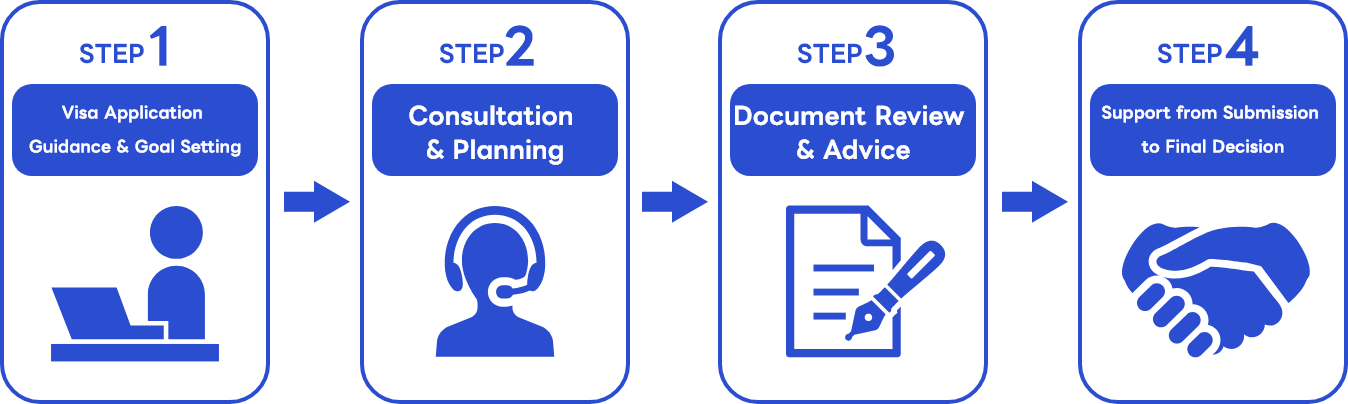
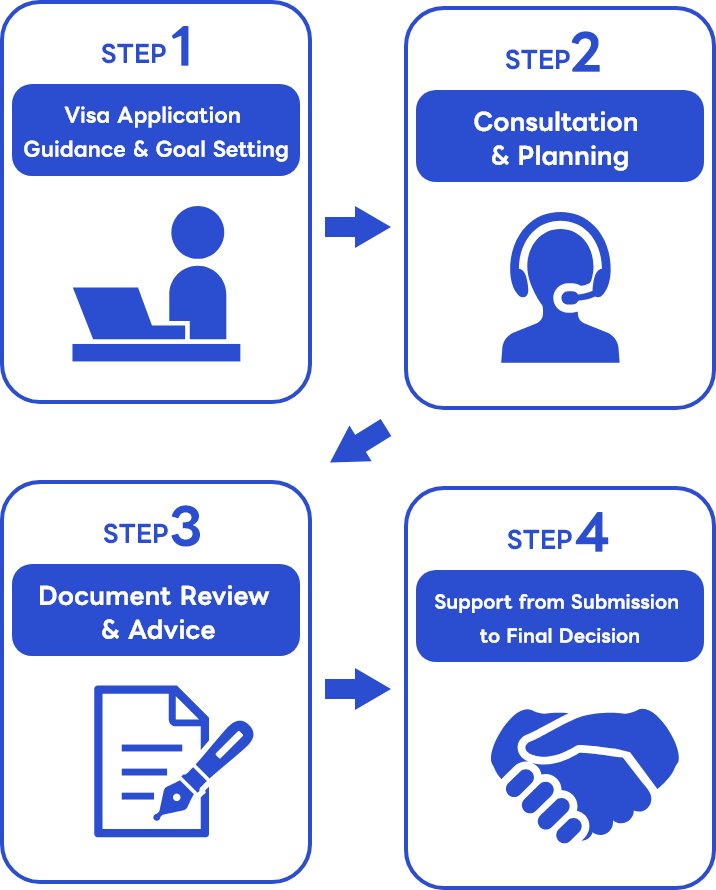
Consulting with an immigration consultant makes the process clearer and much smoother. You’ll feel more confident with document submissions and procedures, significantly reducing the risk of mistakes. Take the first step toward your Canadian dream with the guidance of an expert.