Express Entry Changes Effective November 3, 2026: LMIA Requirements Eased for Qualifying Job Offers
Date Posted:
Last Updated:
On November 3, 2026, Immigration, Refugees and Citizenship Canada (IRCC) introduced a temporary public policy exempting certain qualifying job offers from Labour Market Impact Assessment (LMIA) requirements under Express Entry.
Under this policy, applicants may be able to meet the eligibility requirements for the Federal Skilled Worker Program (FSW) or Federal Skilled Trades Program (FST) using a qualifying job offer, even if their employer has not obtained an LMIA.
The change complements the new CRS points for qualifying high-wage job offers, also effective November 3, 2026.
Qualifying Job Offers May No Longer Require an LMIA
Previously, applicants seeking to use a job offer to meet FSW or FST eligibility requirements generally needed a positive LMIA, unless they qualified under specific LMIA-exempt work permit provisions. Even then, additional conditions could apply.
Under the temporary public policy, certain existing requirements may be waived, including:
- The requirement for the employer to obtain an LMIA
- The requirement for the job offer to come from the employer named on the applicant’s current employer-specific work permit
- The requirement to have worked continuously for that employer for at least one year
These changes may create opportunities for applicants who previously could not use their job offers to meet Express Entry eligibility requirements.
Five Conditions for Job Offers Without an LMIA
Although an LMIA may no longer be required, IRCC will continue to assess the legitimacy of the job offer and the employer’s eligibility. The policy sets out conditions including:
- Active business operations: The employer must be operating a business related to the position offered.
- Reasonable employment need: There must be a legitimate business reason for hiring the applicant.
- Ability to fulfill employment terms: The employer must be able to provide the wages and working conditions offered.
- Relevant experience or education: The applicant must have previous work experience or education related to the occupation.
- Compliance with employment laws: The employer must satisfy applicable requirements concerning prior violations of federal or provincial employment and foreign-worker laws.
Removing the LMIA requirement does not mean that all job offers automatically qualify. IRCC will continue to review the employer’s operations, the need for the position, and the proposed employment conditions.
Job Offers Without an LMIA May Earn 10 Points on the FSW 67-Point Grid
FSW applicants must score at least 67 points on the program’s selection grid, separate from the Express Entry Comprehensive Ranking System (CRS). The grid considers education, language proficiency, work experience, age, adaptability, and arranged employment.
Qualifying arranged employment can provide up to 10 points. Under the new policy, certain LMIA and work-permit requirements may be waived, potentially allowing applicants to claim these points without an LMIA. Applicants who previously fell below 67 points may wish to reassess their eligibility. All other FSW requirements continue to apply.
How This Differs from the New CRS Job Offer Points
IRCC also introduced CRS points for qualifying high-wage job offers effective November 3, 2026:
| Wage level | Additional CRS points |
|---|---|
| At least twice the median wage | 100 |
| At least 1.5 times the median wage | 70 |
| At least 1.3 times the median wage | 50 |
A job offer used to meet FSW or FST eligibility requirements does not necessarily qualify for additional CRS points. An applicant might receive 10 points on the FSW selection grid without meeting the separate occupation, wage, and other conditions for 50, 70, or 100 CRS points.
Who Is Eligible? FSW and FST Applicants Only — Effective November 3, 2026
The temporary public policy took effect on November 3, 2026. It applies to applicants who receive an Invitation to Apply (ITA) on or after that date and apply under FSW or FST. Canadian Experience Class (CEC) is not covered by this temporary public policy.
There is no specified end date, although the Minister of Immigration may revoke the policy at any time.
What This Means for Applicants Seeking Canadian Permanent Residence
The policy may benefit applicants who previously could not use a job offer because their employer did not have an LMIA, including:
- FSW candidates who could reach the 67-point threshold with arranged-employment points
- Applicants with a Canadian job offer but no employer LMIA
- Workers on LMIA-exempt permits who did not meet previous arranged-employment conditions
- Applicants who may qualify separately for high-wage job offer CRS points
Importantly, this policy addresses LMIA-related requirements for permanent residence eligibility. It does not remove the need for a valid work permit or other authorization to work in Canada. A qualifying job offer does not guarantee an ITA or permanent residence approval.
Shiraishi Visa JP Canada assists applicants with assessing Express Entry eligibility, CRS scores, and qualifying job offers to identify potential pathways to Canadian permanent residence.
This article is a summary prepared by Shiraishi Visa JP Canada based on official information from the Government of Canada, organized for clarity and ease of understanding.
Source: Temporary public policy to exempt Labour Market Impact Assessments and related requirements for qualifying job offers for eligibility under Express Entry
Source: Changes to Express Entry for high-wage occupations
Free Consultations and Inquiries
Feel free to get in touch!



Immigration Consultant
Yuki Shiraishi
Born in Japan. After earning a Bachelor's degree from the University of Michigan, she worked for six years in New York as a marketing consultant at a major travel agency, while also studying in an MBA program at the City University of New York. After returning to Japan, she managed the visa center of the same travel company, handling various international visa applications for foreign clients.
Related Columns

Date Posted:September 24, 2026
How to Check Processing Times and Status for Canadian Visa and PR Applications


Date Posted:September 24, 2026
Canada Immigration Policy Trends 2025 | What Fewer Newcomers Mean for PR

Related News
Looking to obtain permanent residence or a visa?
Consult with us now!

Applying for permanent residence or a visa to Canada on your own can be overwhelming due to the large number of required documents, and you may feel uncertain about whether everything is correct. However, if you're serious about immigrating to Canada, we strongly recommend seeking the support of an immigration consultant. There are many pathways to obtaining permanent residence, depending on factors such as your age, occupation, and family status. With the help of an expert, you can ensure that you plan the right approach tailored to your specific situation.
A professional immigration consultant will help solve your concerns
Get a free Counseling now
From immigration planning to application submission,
everything is completed with shiraishi Visa JP Canada
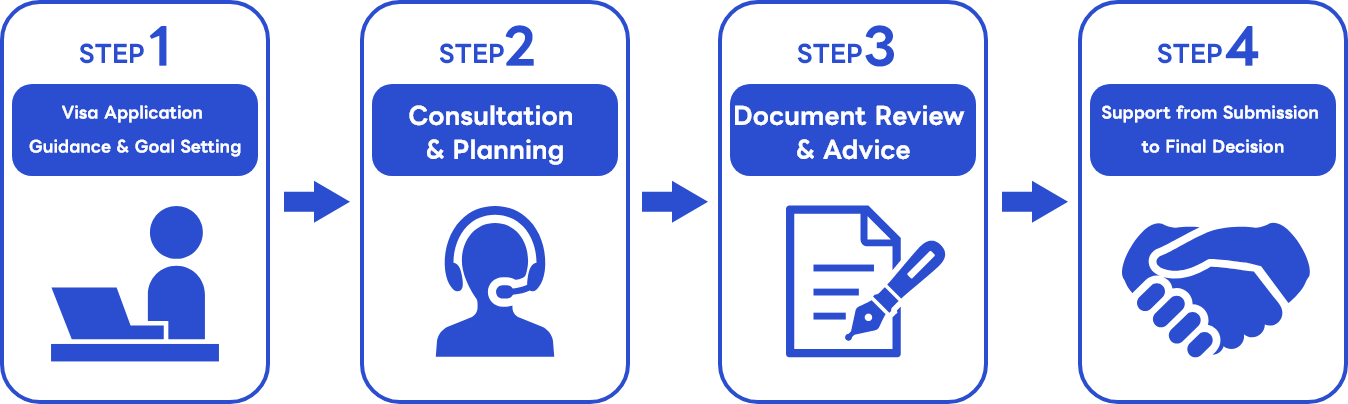
Consulting with an immigration consultant makes the process clearer and much smoother. You’ll feel more confident with document submissions and procedures, significantly reducing the risk of mistakes. Take the first step toward your Canadian dream with the guidance of an expert.