

Canada Immigration Policy Trends 2025 | What Fewer Newcomers Mean for PR
Date Posted:September 24, 2026
Last Updated:September 24, 2026

The 2025–2027 Immigration Levels Plan, announced on October 24, 2024, included a policy of reducing the number of international students and foreign workers to ease the strain on housing and infrastructure.
The Government of Canada aims to reduce temporary residents to 5% of Canada’s population. Based on the latest data as of June 30, 2025, we explain the impact on those aiming for permanent residence.
Update (September 2026): This article describes the situation as of mid-2025, based on the 2025–2027 Immigration Levels Plan and data up to June 30, 2025. The 2026–2028 Immigration Levels Plan, announced in November 2025, has since been published: it sets a permanent resident target of 380,000 per year for 2026–2028 and further reduces new temporary resident arrivals (385,000 in 2026). Please check IRCC for the latest figures.
New international students and foreign workers arriving in Canada
The number of international students and foreign workers entering Canada is declining: arrivals from January to June 2025 were 214,520 fewer than from January to June 2024.
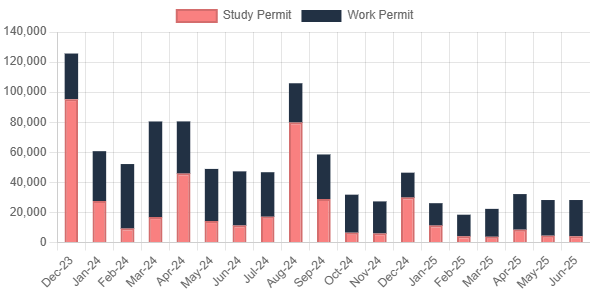
Source: Understanding student and temporary worker numbers in Canada
This downward trend reflects the Government of Canada’s commitment to “implementing a sustainable immigration policy.”
International students in Canada
Arrivals of international students, which exceeded 10,000 in June 2024, fell by half to 4,185 in June 2025. The number of new international students who arrived from January to June 2025 was 88,617 lower than from January to June 2024.
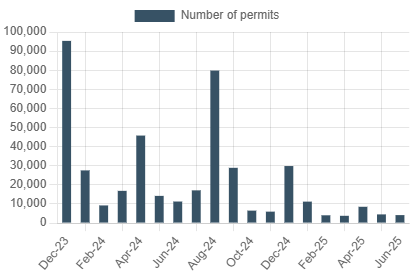
Source: Understanding student and temporary worker numbers in Canada
Study permit data shows seasonal fluctuations and tends to rise sharply in summer. This is because many study permits are issued before September, when the academic year begins.
Policies the Government of Canada has implemented so far
- Cap on international students
In 2024, Canada placed a cap on the number of study permits and announced a further 10% reduction for 2025. - Strengthening the international student program
To prevent study permit fraud, Canada strengthened verification of Letters of Acceptance, raised the financial requirements, and ended the Student Direct Stream, a stream that expedited study permit processing for certain nationalities.
Foreign workers in Canada
Arrivals of foreign workers, about 36,000 in June 2024, fell by roughly 10,000 to 24,058 in June 2025. The number of foreign workers who arrived from January to June 2025 was 125,903 lower than from January to June 2024.
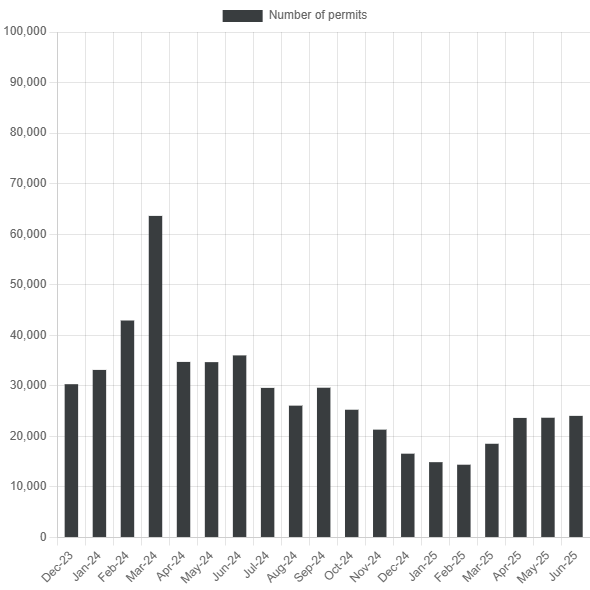
Source: Understanding student and temporary worker numbers in Canada
Policies the Government of Canada has implemented so far
The Government of Canada is focusing on providing employment opportunities to people who are already in Canada.
- Major restrictions on LMIA applications
On September 26, 2024, Canada capped low-wage positions at 10% per workplace (20% in certain high-demand sectors), and LMIA applications can no longer be submitted in urban areas with an unemployment rate of 6% or higher. Since November 8, 2024, the median wage threshold has been raised, bringing more occupations under these restrictions. - Stricter eligibility for the Post-Graduation Work Permit (PGWP)
PGWP eligibility was tightened to better align with immigration policy and labour market needs. - Restrictions on work permits for spouses of temporary residents
Eligibility for work permits for the spouses of international students and foreign workers was tightened.
“Focus on Canada”
Canada’s immigration policy aims not only to achieve sustainable immigration levels but also to support long-term economic growth. The 2025–2027 Immigration Levels Plan emphasizes a “focus on people already in Canada”: of the 197,650 people seeking permanent residence, 82,980, or about 42%, are allocated to those applying based on work experience or education in Canada.
Results for the first half of 2025
Between January and June 2025, more than 100,000 temporary residents obtained permanent residence. Many applied through Express Entry or Provincial Nominee Programs, which are designed to select people who match labour market and regional needs.
According to the statistics, these people have successfully adapted to Canadian society because they have Canadian education or work experience and strong skills in English or French, Canada’s official languages.
Outlook
Canada aims to continue attracting talented people from around the world while easing the strain on infrastructure, housing and services.
Simply living in Canada does not in itself give you an advantage when applying for permanent residence, but since there are many spots for PR applications under the Canadian Experience Class, why not start by aiming to gain at least one year of work experience in a skilled occupation in Canada and improving your English?
Taking the latest policy trends into account, we offer proposals tailored to each client’s situation and wishes, including study permit and work permit application services and optimal planning toward obtaining permanent residence.
Please feel free to contact us through our inquiry form.
Free Consultations and Inquiries
Feel free to get in touch!



Immigration Consultant
Yuki Shiraishi
Born in Japan. After earning a Bachelor's degree from the University of Michigan, she worked for six years in New York as a marketing consultant at a major travel agency, while also studying in an MBA program at the City University of New York. After returning to Japan, she managed the visa center of the same travel company, handling various international visa applications for foreign clients.
Related Columns

Date Posted:September 24, 2026
How to Check Processing Times and Status for Canadian Visa and PR Applications


Date Posted:September 24, 2026
Canada Immigration Policy Trends 2025 | What Fewer Newcomers Mean for PR

Related News
Looking to obtain permanent residence or a visa?
Consult with us now!

Applying for permanent residence or a visa to Canada on your own can be overwhelming due to the large number of required documents, and you may feel uncertain about whether everything is correct. However, if you're serious about immigrating to Canada, we strongly recommend seeking the support of an immigration consultant. There are many pathways to obtaining permanent residence, depending on factors such as your age, occupation, and family status. With the help of an expert, you can ensure that you plan the right approach tailored to your specific situation.
A professional immigration consultant will help solve your concerns
Get a free Counseling now
From immigration planning to application submission,
everything is completed with shiraishi Visa JP Canada
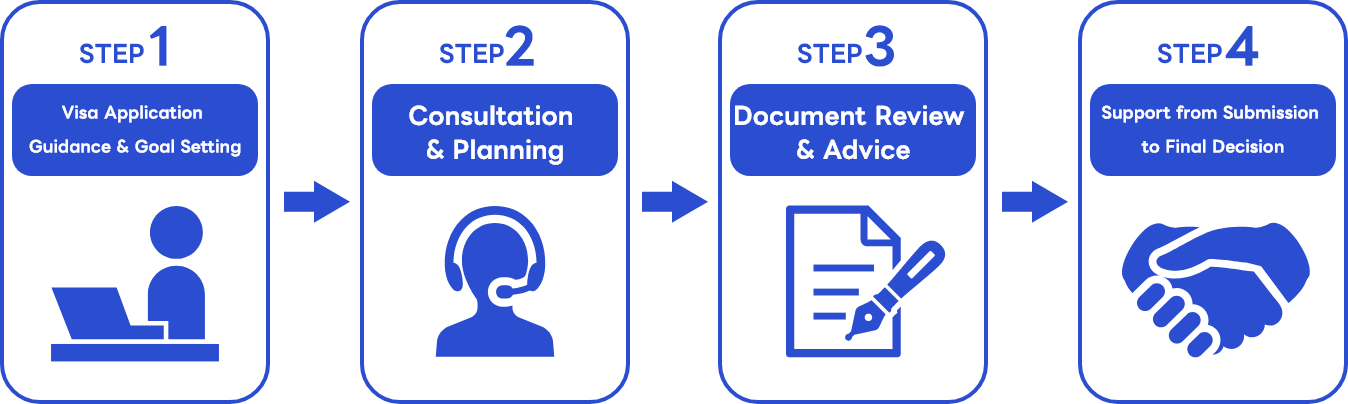
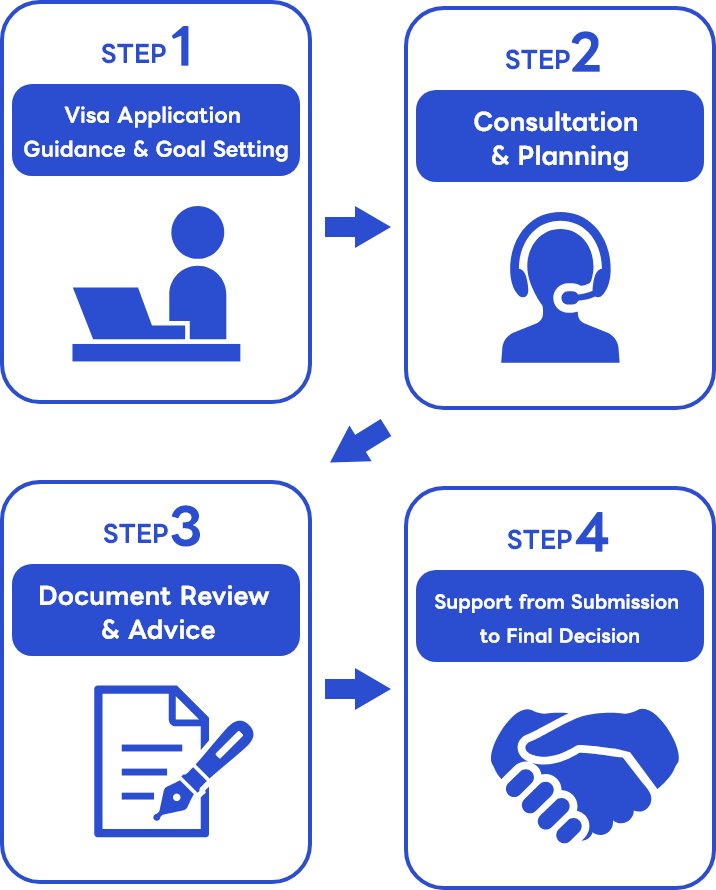
Consulting with an immigration consultant makes the process clearer and much smoother. You’ll feel more confident with document submissions and procedures, significantly reducing the risk of mistakes. Take the first step toward your Canadian dream with the guidance of an expert.
Tag list
Popular Rankings

September 24, 2026
Express Entry Jobs for Canadian PR: Easy-to-Start Occupations with No Experience
If you are aiming to fast-track your path to Canadian permanent residence, Express Entry’s category-

September 24, 2026
Provincial Nominee Programs to Expand Significantly in 2026
In December 2025, the Government of British Columbia announced its 2026 nomination allocation under

September 24, 2026
Stricter Screening for the Significant Benefit Work Permit (C10), Including the Entrepreneur Work Permit| Policy Changes and Application Strategies
On February 24, 2026, IRCC updated its guidelines for the Significant Benefit (C10) category, one of

September 24, 2026
PNP and AIP Program Updates: Growing Restrictions Across Canadian Provinces (As of July 2025)
In 2025, several Canadian provinces and territories have introduced new limits and priority criteria