Canada Announces Low-Wage LMIA Reforms: Employment Duration Extended to Two Years, Proposed 15% Workforce Cap
Date Posted:
Last Updated:
On November 6, 2026, the Government of Canada announced targeted reforms to the Temporary Foreign Worker Program (TFWP), including changes to its Low-wage Stream.
Two measures took effect immediately: extending the maximum employment duration supported by a Low-wage Labour Market Impact Assessment (LMIA) to two years, and easing LMIA processing restrictions for eligible early childhood educators (ECEs).
The government also proposed further changes beginning March 1, 2027, subject to provincial and territorial participation. These include a potential increase in the general cap on low-wage temporary foreign workers from 10% to 15% in designated areas and new regional and occupation-based rules.
Below is an overview of the changes and their implications for employers and foreign workers.
1. Maximum Low-wage LMIA employment duration extended from one year to two years
Effective date: November 6, 2026
Previously, employment under the Low-wage Stream was generally limited to a maximum of one year. For Low-wage LMIA applications submitted on or after November 6, 2026, the maximum employment duration has been extended to two years. This may help employers plan staffing over a longer period and reduce the administrative burden and cost of repeat LMIA applications. It may also give foreign workers greater continuity in their employment plans.
A two-year period is not automatically approved for every application. In addition, the validity of a work permit is determined separately by Immigration, Refugees and Citizenship Canada (IRCC), taking into account factors such as passport validity and applicable requirements.
2. Eligible early childhood educators exempted from the 6% unemployment-rate processing restriction
Effective date: November 6, 2026
As a general rule, Low-wage LMIA applications for positions in census metropolitan areas (CMAs) with unemployment rates of 6% or higher are not processed, subject to exceptions for certain priority sectors.
The government has now added early childhood educators (ECEs) to the exception, allowing eligible Low-wage LMIA applications for these positions to be processed even in CMAs with unemployment rates of 6% or higher. This is an important development for childcare providers facing recruitment challenges. However, being exempt from the processing restriction does not guarantee a positive LMIA decision; the application must still satisfy the applicable requirements.
The announcement refers to early childhood educators. Whether early childhood educator assistants (ECEAs) are also covered should be verified against the detailed program instructions before applying.
3. Proposal to increase the low-wage foreign-worker cap from 10% to 15%
Proposed start date: March 1, 2027 — subject to provincial or territorial participation
Under the general Low-wage Stream rules, employers are normally subject to a cap of 10% on the proportion of temporary foreign workers in low-wage positions at a work location. Under the proposed approach, eligible employers in areas designated by participating provinces or territories could be permitted a cap of 15%. This could be particularly significant for employers who have been unable to hire additional foreign workers because they have reached the existing cap.
For illustration, if an employer has 40 employees, a simple percentage calculation would produce the following comparison:
| Cap | Illustrative number of workers |
|---|---|
| Current 10% | 4 |
| Proposed 15% | 6 |
Actual permitted numbers depend on ESDC’s calculation rules, the relevant work location, and applicable exemptions. Priority sectors currently eligible for a 20% cap are expected to retain that cap.
Importantly, the proposed 15% cap would not apply automatically across Canada. Provinces and territories would have to opt in and designate eligible areas.
What about British Columbia?
In April 2026, British Columbia indicated that it would not participate in a separate temporary measure increasing the low-wage cap from 10% to 15% in rural areas, although it participated in a measure allowing existing workforce levels to be maintained. It remains necessary to confirm whether British Columbia will participate in the newly proposed measures for March 2027. Employers in BC should not assume that a 15% cap will apply.
4. Proposed regional and occupation-based LMIA processing rules
Proposed start date: March 1, 2027 — subject to provincial or territorial participation
The government also proposed a more targeted system for determining which Low-wage LMIA applications can be processed, taking into account local labour-market conditions and occupational shortages.
| Area | Proposed treatment |
|---|---|
| CMAs with unemployment of 6% or higher | Generally not processed, with exceptions for priority sectors |
| CMAs with populations above 250,000 and unemployment below 6% | Restricted to occupations identified through COPS and those designated by participating jurisdictions |
| Rural areas within larger CMAs and CMAs with populations of 100,000–250,000 | Restricted to occupations identified through COPS and those designated by participating jurisdictions |
| Rural areas | Generally open to applications across occupations |
COPS stands for the Canadian Occupational Projection System, which assesses projected labour supply and demand by occupation. Participating provinces and territories would have flexibility to adapt the occupations eligible in their jurisdictions. As a result, an employer in a metropolitan area with an unemployment rate below 6% could still face restrictions based on the occupation. Detailed occupation lists, regional definitions, and implementation rules will need to be confirmed as they are released.
5. Support for pathways to permanent residence
The announcement also discusses support for helping temporary foreign workers already in Canada transition to permanent residence, including additional Provincial Nominee Program (PNP) allocations and use of existing federal economic immigration pathways.
These measures do not automatically grant permanent residence eligibility to everyone working under a Low-wage LMIA. Eligibility continues to depend on the relevant immigration program, occupation, work experience, education, language ability, and provincial requirements.
6. What employers and foreign workers should review
The reforms may offer greater flexibility through longer employment periods and, where adopted, a higher low-wage workforce cap. At the same time, the proposed 2027 rules could limit access to Low-wage LMIAs for certain occupations and regions. Employers and foreign workers should review the following:
- Whether the offered position qualifies under the Low-wage Stream
- The unemployment rate and geographic classification of the work location
- The applicable cap on low-wage temporary foreign workers
- Whether the province or territory participates in the proposed measures
- Any occupation-specific restrictions applicable to applications submitted from March 2027 onward
Summary: Two Changes Already in Effect, With March 2027 Proposals Depending on Provinces and Territories
Two Low-wage LMIA changes took effect on November 6, 2026: a maximum employment duration of two years and a new processing exception for eligible early childhood educators in CMAs with unemployment rates of 6% or higher. Additional reforms proposed for March 2027 could raise the general low-wage foreign-worker cap to 15% in designated areas while introducing more targeted regional and occupational restrictions. These proposals depend on provincial and territorial participation and further implementation details.
Shiraishi Visa JP Canada assists employers and foreign workers with LMIA applications, work permits, and Canadian immigration matters. Please contact us to discuss how these changes may affect your hiring or immigration plans.
Information current as of November 9, 2026. Measures proposed for March 2027 are subject to change.
This article is a summary prepared by Shiraishi Visa JP Canada based on official information from the Government of Canada, organized for clarity and ease of understanding.
Source: Government of Canada announces targeted reforms to the Temporary Foreign Worker Program to respond to labour market needs
Source: Temporary measures under the Temporary Foreign Worker Program
Free Consultations and Inquiries
Feel free to get in touch!



Immigration Consultant
Yuki Shiraishi
Born in Japan. After earning a Bachelor's degree from the University of Michigan, she worked for six years in New York as a marketing consultant at a major travel agency, while also studying in an MBA program at the City University of New York. After returning to Japan, she managed the visa center of the same travel company, handling various international visa applications for foreign clients.
Related Columns




Related News
Looking to obtain permanent residence or a visa?
Consult with us now!

Applying for permanent residence or a visa to Canada on your own can be overwhelming due to the large number of required documents, and you may feel uncertain about whether everything is correct. However, if you're serious about immigrating to Canada, we strongly recommend seeking the support of an immigration consultant. There are many pathways to obtaining permanent residence, depending on factors such as your age, occupation, and family status. With the help of an expert, you can ensure that you plan the right approach tailored to your specific situation.
A professional immigration consultant will help solve your concerns
Get a free Counseling now
From immigration planning to application submission,
everything is completed with shiraishi Visa JP Canada
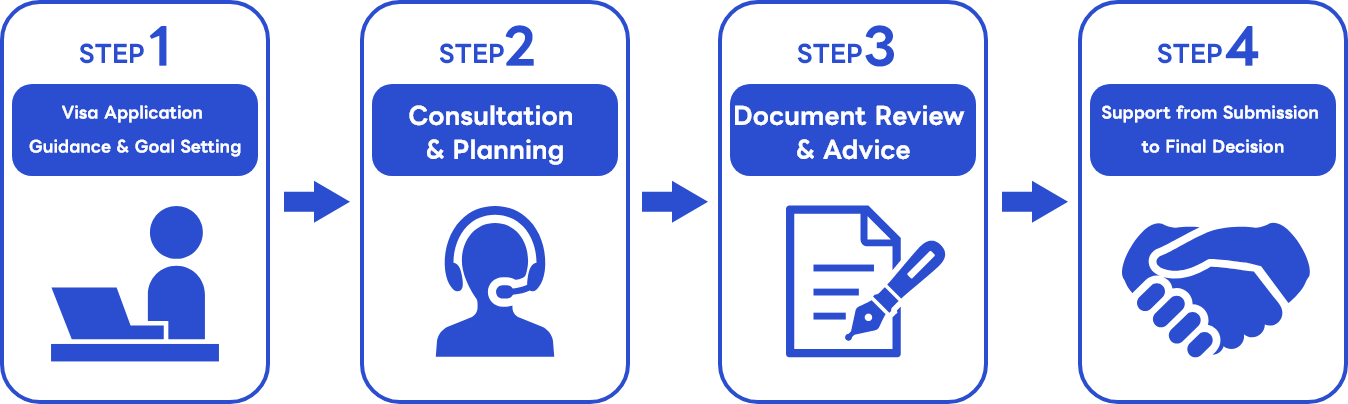
Consulting with an immigration consultant makes the process clearer and much smoother. You’ll feel more confident with document submissions and procedures, significantly reducing the risk of mistakes. Take the first step toward your Canadian dream with the guidance of an expert.