

Canada Expands Access to Low-Wage LMIAs for Employers with Multiple Small Work Locations
Date Posted:August 26, 2026
Last Updated:September 24, 2026
On August 18, 2026, the Government of Canada updated the rules governing the cap on low-wage temporary foreign workers under the Temporary Foreign Worker Program (TFWP).
The change may allow employers operating multiple small stores or worksites to use the Low-Wage Labour Market Impact Assessment (LMIA) stream at more of their locations.
What is the cap under the Low-Wage LMIA stream?
The Low-Wage Stream limits the proportion of an employer’s workforce at a particular work location that can consist of low-wage temporary foreign workers. The purpose of the cap is to prevent employers from becoming overly reliant on foreign workers.
As a general rule, low-wage temporary foreign workers may make up no more than 10% of the workforce at a specific work location.
A 20% cap applies to certain sectors and occupations, including:
- Construction
- Food manufacturing
- Hospitals
- Nursing and residential care facilities
- Certain in-home caregiving and childcare occupations
A special calculation for employers with fewer than 10 employees already existed
If a work location has fewer than 10 employees, hiring even one temporary foreign worker could cause the employer to exceed the applicable 10% or 20% cap under the ordinary calculation.
For this reason, the federal government already had a special calculation for small employers. For cap calculation purposes, eligible employers with fewer than 10 employees were instructed to use a deemed workforce size of 10.
This allowed them to employ the following number of low-wage temporary foreign workers:
| Applicable cap | Maximum number of low-wage temporary foreign workers |
|---|---|
| 10% | 1 |
| 20% | 2 |
Therefore, the ability of an employer with fewer than 10 employees to hire one or two low-wage temporary foreign workers is not itself a new rule.
Previously, the employer had to have fewer than 10 employees across all Canadian worksites
The August 18 update changes which employers may use this special calculation.
Previously, an employer generally had to have fewer than 10 employees in total across all its worksites in Canada to qualify.
As a result, a company could be ineligible for the special calculation even when each of its stores or worksites was small, if its combined Canadian workforce was 10 or more.
The standard Low-Wage Stream cap was already calculated separately for each work location. What changed is the eligibility test for the special calculation that deems a small employer’s workforce to be 10.
Eligibility is now determined at each work location
Effective August 18, 2026, eligibility for the special calculation is determined based on the number of employees at each individual work location, rather than the employer’s total workforce across Canada.
If a particular location has fewer than 10 employees, the employer may use a deemed workforce size of 10 for the cap calculation at that location—even if the company employs 10 or more people across all its Canadian operations.
This may allow the employer to employ:
- Up to one low-wage temporary foreign worker at each eligible location under the standard 10% cap
- Up to two low-wage temporary foreign workers at each eligible location under the 20% cap
How the change affects employers with multiple locations
Let us compare a specific example to see the impact of this rule change.
Condition A company operating three stores with seven employees working at each store (Total company workforce is 21 employees)
| Category | Before the Rule Change (Previous) | After the Rule Change (From August 18 2026) |
| Application of Special Calculation | Not Applicable (Total workforce across all locations is 21 which is 10 or more) | Applicable (Workforce at each individual store is 7 which is fewer than 10) |
| Employment Capacity for 10 Percent Cap | Cannot hire (Does not meet criteria) | Up to 1 person per store (Maximum of 3 people across 3 stores) |
| Employment Capacity for 20 Percent Cap | Cannot hire (Does not meet criteria) | Up to 2 people per store (Maximum of 6 people across 3 stores) |
In this way, being able to calculate the cap by assuming a workforce of 10 employees for each individual store provides a significant advantage for companies operating multiple locations.
Who is included in the workforce calculation?
The workforce size at each location includes:
- Full-time employees
- Part-time employees
- Temporary foreign workers employed through the LMIA process
- Foreign nationals working under other types of work permits
- Employees on leave who are expected to return
- Temporary foreign workers with previously approved LMIAs who have not yet started working
- Vacant positions for which temporary foreign workers are being requested in the current LMIA application
A full-time employee is someone who works an average of 30 or more hours per week. A part-time employee works an average of fewer than 30 hours per week and is counted as 0.5 of an employee for cap calculation purposes.
Other Low-Wage LMIA requirements continue to apply
This update concerns only the calculation of the cap. It does not represent a general relaxation of the requirements under the Low-Wage Stream.
Employers must continue to meet all other applicable requirements, including those relating to recruitment and advertising, efforts to hire Canadians and permanent residents, round-trip transportation costs, suitable and affordable housing, and private health insurance where required.
The refusal-to-process policy for Low-Wage LMIA applications in census metropolitan areas with an unemployment rate of 6% or higher also continues to apply, subject to existing exemptions for certain sectors and occupations.
Comments from Shiraishi Visa JP Canada
The August 18 update does more than simply clarify that an employer with fewer than 10 employees may hire one or two low-wage temporary foreign workers.
That special calculation already existed. Previously, however, an employer generally had to have fewer than 10 employees across all its Canadian worksites to qualify. The eligibility test is now applied separately to each work location.
For a small employer operating only one location, the practical result may be largely unchanged. For employers operating multiple small locations—such as restaurants, retail stores, cleaning businesses and care-related facilities—the change could result in a meaningful increase in the number of locations at which Low-Wage LMIAs may be used.
Employers should nevertheless be prepared to establish that each store or worksite is a genuine work location and that the workforce calculation for each location is accurate. Payroll records and other location-specific business documents may be required to support the LMIA application.
With the recent changes to the LMIA cap rules, many hiring managers and business owners may be wondering how many foreign workers they can now employ at each location or whether they meet the conditions to proceed with an LMIA application under the new rules.
At the Shiraishi Visa JP Canada free consultation, we carefully listen to your current business operations, workforce size, and future hiring plans, and clearly guide you through the overall application process based on the latest general LMIA guidelines.
- You want to understand the general requirements and cap rules for utilizing LMIAs across multiple locations of your company
- You want to grasp the basic conditions required under the Low-Wage Stream, such as job advertisements and transportation costs
If this applies to you, please feel free to utilize our free consultation. Please note that the free consultation is limited to listening to your current situation and providing general information about the system. Specific cap calculations based on your company’s actual employee data, concrete application document preparation support, and LMIA application representation are provided through paid individual counseling (consulting) by our government-authorized consultants. Please start by organizing your current situation with our free consultation.
Free Consultations and Inquiries
Feel free to get in touch!



Immigration Consultant
Yuki Shiraishi
Born in Japan. After earning a Bachelor's degree from the University of Michigan, she worked for six years in New York as a marketing consultant at a major travel agency, while also studying in an MBA program at the City University of New York. After returning to Japan, she managed the visa center of the same travel company, handling various international visa applications for foreign clients.
Related Columns




Related News
Looking to obtain permanent residence or a visa?
Consult with us now!
Applying for permanent residence or a visa to Canada on your own can be overwhelming due to the large number of required documents, and you may feel uncertain about whether everything is correct. However, if you're serious about immigrating to Canada, we strongly recommend seeking the support of an immigration consultant. There are many pathways to obtaining permanent residence, depending on factors such as your age, occupation, and family status. With the help of an expert, you can ensure that you plan the right approach tailored to your specific situation.
A professional immigration consultant will help solve your concerns
Get a free Counseling now
From immigration planning to application submission,
everything is completed with shiraishi Visa JP Canada
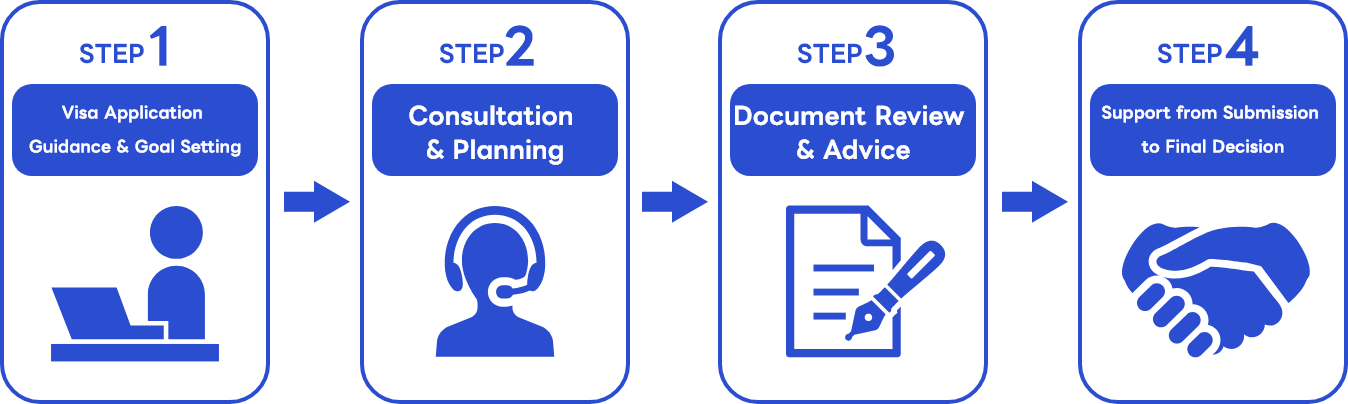
Consulting with an immigration consultant makes the process clearer and much smoother. You’ll feel more confident with document submissions and procedures, significantly reducing the risk of mistakes. Take the first step toward your Canadian dream with the guidance of an expert.